
Torque Rod Bushing Replacement Guide for Fleet Techs
A worn torque rod bushing is a common source of clunking and axle wander on heavy-duty trucks, and it’s a repair most fleet technicians can handle in-house with the right tools and a bit of care around torque sequence. This guide walks through why the bushing wears out, what you’ll need on hand, and the replacement steps that keep the job from turning into a comeback.
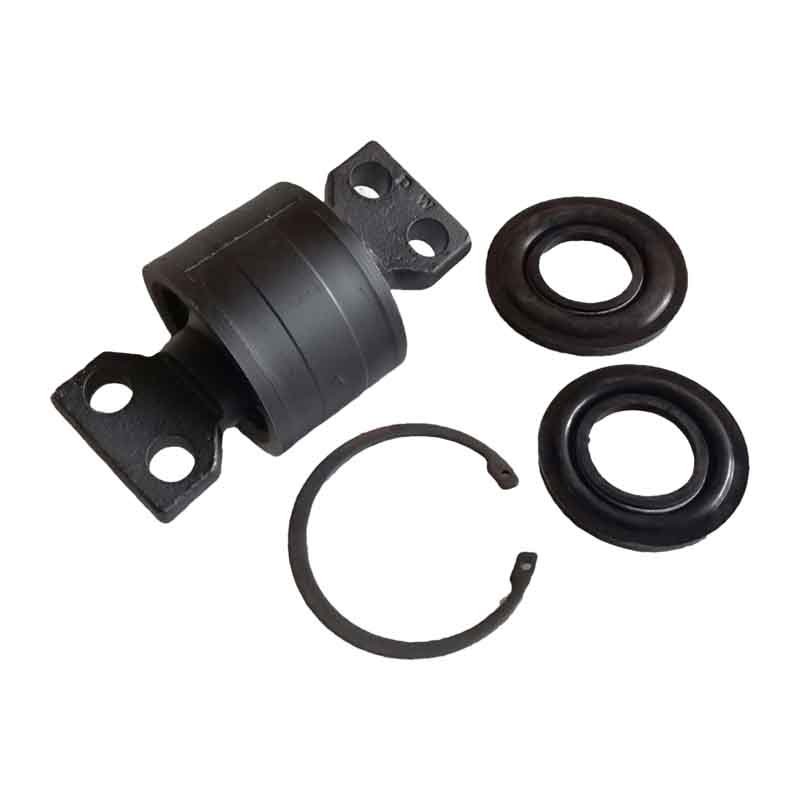
Why Torque Rod Bushings Wear Out
The torque rod bushing absorbs every torque reaction transmitted from the axle to the frame under acceleration and braking, which means it’s under constant twisting load even on a smooth road. Add road salt, oil contamination, and years of heat cycling, and the rubber eventually cracks, separates from its sleeve, or tears through entirely — at which point the axle is free to shift position (axle “walk”) instead of staying locked to the frame.
Tools You’ll Need
- Impact wrench and a socket set matched to the torque rod’s pin/bolt size
- A bushing press (or a hydraulic press and suitable adapters) for pressed-in bushings
- Penetrating oil, for pins and bolts that haven’t moved in years
- A torque wrench rated for the fastener’s specified torque value
- A floor jack and stands, or a lift capable of supporting the axle at ride height
Step-by-Step Replacement
- Support the axle so it’s sitting at normal ride height, not hanging free — this matters for the torque step later.
- Soak the mounting bolts or pins with penetrating oil, then remove the torque rod from the axle bracket and frame bracket.
- Press the old bushing out of the torque rod eye, supporting the rod itself so the press load doesn’t bend it.
- Clean the bore of any rust, old rubber, or burrs before pressing in the new bushing squarely and evenly.
- Reinstall the torque rod, starting all bolts by hand before snugging any of them down.
- With the axle still at ride height, torque the bushing bolts to the manufacturer’s specification — this preloads the rubber correctly instead of leaving it twisted.
- Recheck alignment if the torque rod controls axle positioning, and inspect the opposite side’s bushing while you’re under the truck.
Why Ride-Height Torque Matters
Tightening the bushing bolts while the suspension is drooped (hanging free on a lift) locks the rubber in a twisted position, which shortens its service life even if every other part of the job was done correctly. Torquing at ride height — the position the axle sits in under the truck’s own weight — is a small step that’s easy to skip and one of the most common reasons a “properly installed” bushing fails early.
Sourcing OEM-Equivalent Replacements
A replacement bushing needs to match the original rubber compound and durometer, not just the outer dimensions — the wrong compound will either wear out early or transmit more noise and vibration than the truck was designed for. Working with a manufacturer that produces both the rubber and metal sleeve in-house, rather than sourcing them from separate suppliers, generally means tighter tolerances and more consistent quality across repeat orders.
Need help cross-referencing a torque rod bushing part number? Reach out to our team for OEM cross-reference support and a factory-direct quote.